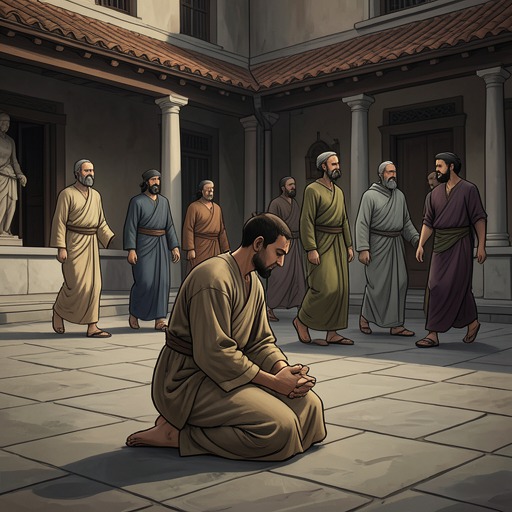
Humility (Khien)
I ChingHumility (Khien), Hexagram XV, makes self-abasement a form of durable strength rather than weakness: the hexagram promises progress and success when a person’s undertakings are shaped by humility, and its closing line permits force only to correct wrongs within one’s own sphere. Its sequence moves from humility practiced without display, through recognition and responsible rule, to a bounded assertion of justice.
Meaning and Structure
The hexagram’s general judgment links progress and success to the superior man’s humility. In the accompanying account, this is not a call to abandon action: the image of crossing a great stream makes clear that humility can accompany a difficult undertaking, and the text associates that crossing with good fortune. The virtue matters because it governs how strength is exercised, not because it prevents movement or achievement.
The commentary places Humility after the hexagram of abundant possessions: an essay on humility rightly follows one on abundance. The contrast gives the sequence an ethical emphasis. Possession and power do not themselves secure lasting success; humility offers the means by which success can endure. The commentary’s concise conclusion is that humility is the way to permanent success.
The Lines and Their Progression
At the bottom of the hexagram, a weak line represents the superior man adding humility to humility. The image makes the virtue cumulative: its first expression is not a public claim or a display of authority, but continued self-restraint. The line’s promise that even a great stream may be crossed with good fortune joins that inward disposition to effective action.
The second line is weak, central, and in its proper place. Its humility has become recognized—described in the commentary as having “crowed,” or proclaimed itself. The wording marks a change from private practice to acknowledged conduct, while the line’s proper position and centrality frame that recognition as compatible with good fortune when joined to firm correctness.
The commentary identifies the third line, a whole line among five divided ones and at the top of the lower trigram, as the lord of the hexagram according to the Khang-hsî editors and many others. It represents humility that is strong yet abases itself. The commentary says the text offers no basis for pursuing the figure’s symbolism further, keeping the interpretation anchored instead in the broader claim that humility secures enduring success.
At the fourth line, humility occupies its proper position and is expected to bring success and prosperity. Yet proximity to the fifth line—the ruler’s place—requires the subject to exercise the greatest precaution. The line’s promise is therefore qualified by political circumstance: approaching authority does not remove the need for restraint.
Authority, Force, and Limits
The fifth line presents a ruler who may be neither especially rich nor powerful, yet whose humility wins the allegiance of his neighbours. The commentary explains this response by saying that people love and honour humility in itself, without the attributes that usually command obedience and respect. Humility can therefore sustain authority without relying on wealth or strength alone.
That restraint does not forbid the ruler from asserting what is right, even by force of arms. The final line sharpens the limit: its subject stands outside the game that has already been played out and will use force only within his own sphere, punishing his own towns and state. The commentary reads this as an assertion of right, not aggression. The hexagram’s conclusion thus distinguishes disciplined enforcement from expansion: humility can coexist with force when force remains bounded by responsibility.
Ethical Significance
Across the lines, humility changes its setting without losing its governing principle. It begins as repeated self-restraint, becomes recognizable conduct, defines the strong figure at the center of the hexagram, and informs both the ruler’s following and the use of force. The changing circumstances test the same virtue: good fortune depends not on refusing action, but on acting without turning strength or authority into self-assertion.
The commentary also cautions against making the line imagery carry more than the text supports. It identifies a traditional interpretation of the third line but declines to elaborate symbolism not present in the words themselves. That restraint in interpretation parallels the hexagram’s ethical emphasis: claims should remain proportionate to their grounds, just as authority should remain within its proper bounds.